.webp)
A Few Big Days in Las Vegas
InfoComm is one of those shows where the whole industry shows up in one room. That makes for a busy floor and even busier days. We had both Simpleway and nnounce on the stand, and the foot traffic kept us on our toes from open to close.
The best part was the people. We talked with integrators sizing up their next mission-critical bid, AV pros who live and breathe Q-SYS, transit and airport teams who know exactly how a paging system behaves at 6 a.m. on a Monday, and plenty of familiar faces we only ever see once a year. Those hallway chats are the reason we keep coming back.
The Big Reveal: nnounce Distributed Paging
This year we announced nnounce distributed paging, and it is the project our team has been pouring itself into for months.
It is a different way to think about paging. Most systems lean on one central unit to hold control, route the audio, and do the processing. That unit is the brains, and it is also the weak spot. If it goes down, the building goes quiet. Distributed paging removes that central unit entirely.
What Is Distributed Paging?
Here is the short version. Instead of one box running the show, every device runs its own piece. Each device holds its own queue and makes its own decisions. They talk to each other directly, over the standard IP network already in the building.
What does that get you?
- No single point of failure. If one device reboots or drops out, the rest of the system keeps paging.
- Room to grow. You scale by adding devices, not by ripping out and upgrading a central appliance.
- No central bottleneck. Audio moves point to point, so there is no funnel to choke the system.
Now for the part people worried about when they heard the word "distributed." Doesn't managing a system with no central brain turn into a nightmare? It doesn't. You configure and manage the entire network as one system inside the nnounce studio. One place for setup, updates, user management, and records. The control feels centralized even though the execution is spread across every device. That combination is the whole point.
Best Paging System at InfoComm 2026
We had a feeling distributed paging would land well. We did not expect to walk away with a trophy.
nnounce distributed paging earned a Best of InfoComm 2026 Award from rAVe [PUBS], recognized as the best paging system at the show. Coming from a team that watches this industry closely, that one meant a lot to us.
rAVe also sat down with one of our colleagues for a video that goes deeper into how distributed paging works and why it matters. If you want the story straight from the people who built it, it is worth a few minutes.
The Devices Behind Distributed Paging
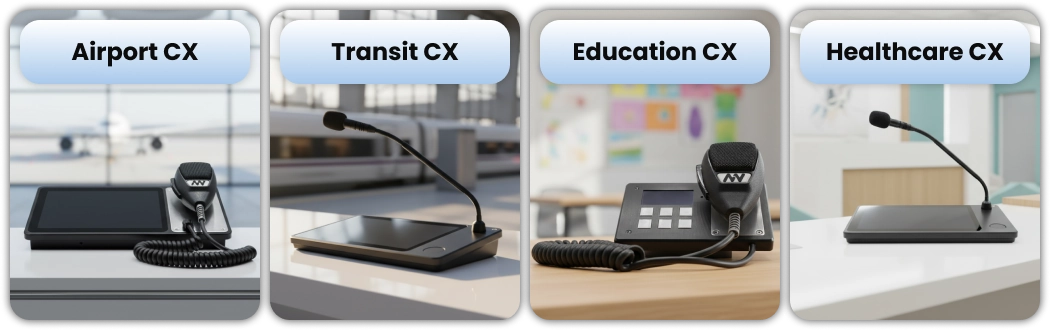
Distributed paging is the idea. The nnounce hardware is where it lives. We brought a good slice of the lineup to the booth, including paging stations, amplifiers, and the integration devices that tie a system together.
People kept picking them up, which is exactly what we hoped for. The look is clean and understated, and the build is rugged enough for the demanding sites these products are made for. Elegant on the wall, tough where it counts.
That strength carries into the software side too. Most of the nnounce lineup is Q-SYS Verified and listed in the Q-SYS library, so the devices show up in the environment integrators already work in. They drop into the Q-SYS Ecosystem through a Q-SYS Verified plugin, which makes adding nnounce to a Q-SYS design a known, supported path rather than a workaround.
Built Hand in Hand with Simpleway
One more thing worth saying out loud. nnounce was not bolted onto our communication platform after the fact. It was built alongside the Simpleway communication system from day one, by teams that sit in the same building and solve the same problems.
That shared history shows. The two share the same foundation, so they fit together in a way a third-party pairing never can. You get one operator experience, one source of truth, and a paging layer that already speaks the same language as the rest of the platform. That kind of integration is hard to match, and it is exactly the kind you only get when both products grow up together.
It also means nnounce plays nicely with what is already installed at your site. Keep your existing DSP, amplifiers, speakers, and network. nnounce sits on top as the operator and paging layer, so the upgrade does not trigger a full infrastructure refresh.
Let's Talk
Whether you are bidding a mission-critical tender, rethinking the paging layer in an airport or transit hub, or just curious how distributed paging would fit your site, we would love to hear what you are working on.
Reach out and let's figure it out together.
%20(1).webp)
.webp)

.webp)